

- Sternberg Law Office
The wage benefit is the part of a workers’ compensation claim that determines whether a household stays afloat, and it is calculated in a way that surprises most injured workers.
You do not receive your wages. You receive a percentage of an average calculated from a defined period before the accident, subject to a statewide cap.
Average Weekly Wage Is the Foundation
Everything begins with the average weekly wage, generally calculated from earnings over the 13 weeks preceding the accident, excluding the week of the injury.
Where a worker was not employed during that period, alternative methods apply, including using the wages of a similar employee performing the same work.
Getting this figure right matters more than anything else in the wage calculation, and Sternberg Law Office checks it against your own records, because every benefit is a percentage of it. An error here repeats through the entire claim.
The calculation should include overtime, bonuses, and the employer’s contribution to fringe benefits in defined circumstances. Carriers frequently calculate on base wages alone, and the resulting figure is too low.
Workers who held a second job may be able to include those concurrent earnings, a point that is regularly overlooked.
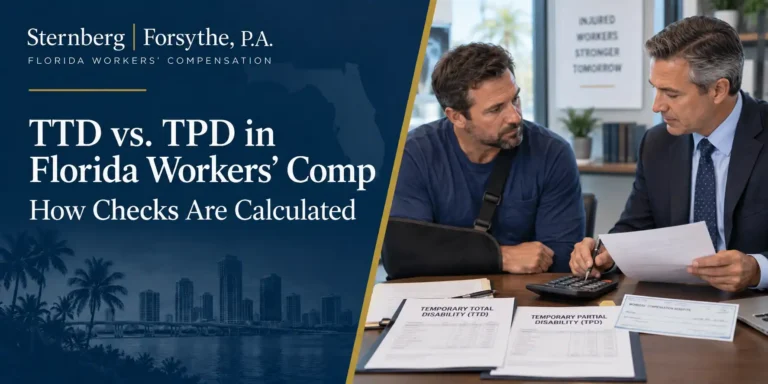
Temporary Total Disability
Where a physician takes you entirely off work, temporary total disability benefits apply.
The benefit is generally two-thirds of the average weekly wage, subject to a statewide maximum that adjusts annually. A higher percentage applies for a limited period where the injury is catastrophic in defined respects.
The statewide cap matters for higher earners. A worker whose two-thirds calculation exceeds the maximum receives the maximum, which can be a substantial reduction relative to actual earnings.
Temporary Partial Disability
Where you can work with restrictions but earn less than before, temporary partial disability applies.
The benefit is calculated based on the difference between a percentage of your average weekly wage and what you are actually earning, so it fills part of the gap rather than all of it.
It also applies when you have restrictions and the employer cannot accommodate them, provided you conduct a good-faith work search. Florida requires documentation of that search, and failing to keep it is a common reason benefits stop.
Workers often do not realize the work search obligation exists until benefits are denied for non-compliance
The Waiting Period
Florida imposes a waiting period before wage benefits begin. Compensation is not payable for the first several days of disability unless the disability extends beyond a defined longer period, at which point the initial days become payable retroactively.
This means a worker out for a short period may receive no wage benefit at all, and a worker out longer eventually receives the earlier days as well.
Concurrent Employment and Second Jobs
A worker holding more than one job at the time of the accident may be able to include earnings from both in the average weekly wage.
This is regularly missed. A carrier calculating from the employer of record has no visibility into a second job, and the worker does not know the earnings should be included.
Where an injury prevents performing either job, the difference in the resulting benefit can be substantial. Producing pay records from the second employer early is what secures it.
How Long Temporary Benefits Last
Florida caps the total duration of temporary benefits, combining temporary total and temporary partial, at a maximum number of weeks.
Reaching that cap while still not at maximum medical improvement creates a genuine gap, and Florida appellate litigation has addressed the problem. It remains a serious practical issue for workers with long recoveries.
Benefits also end when maximum medical improvement is reached, at which point impairment benefits begin at a lower rate.
Death Benefits
Where a workplace injury results in death, Florida provides benefits to dependents, and they operate on their own framework.
Compensation is payable to a surviving spouse and dependent children on a defined schedule, subject to an overall statutory limit. Funeral expenses are covered up to a capped amount, and educational benefits may be available to a surviving spouse.
The statutory limit on total death benefits is low relative to the loss, which is a substantial argument for examining whether a third-party claim exists alongside the compensation claim.
Other Income and Offsets
Receiving other benefits can affect the workers’ compensation payment.
Social Security disability benefits and workers’ compensation are subject to offset provisions when the combined amount exceeds a threshold. Unemployment compensation and reemployment assistance also interact with these benefits.
Working while receiving benefits is permitted under specific circumstances and must be reported. Failing to report earnings while collecting benefits is considered fraud in Florida, and the consequences include forfeiture of the entire claim and potential criminal liability.
That is worth stating plainly. The temptation to work cash jobs while a claim is pending has ended more Florida claims than almost any other single factor, and carriers conduct surveillance specifically looking for it.
Settlement and Washout Agreements
Most Florida claims eventually resolve through a settlement, and understanding what is being given up matters.
A settlement typically closes indemnity benefits and, in most cases, future medical benefits as well. Once approved, the claim is over — future surgery, medication, and treatment become your responsibility.
That is why settling before the medical picture is clear is risky. A worker who settles before knowing whether a further procedure is needed absorbs that cost personally.
Where the worker is a Medicare beneficiary or reasonably expects to become one, federal interests in future medical costs must also be considered, and that consideration affects how a settlement is structured.
Settlement figures are also net of attorney fees and any liens, and the number that matters is what reaches the worker, not the headline amount.
Penalties and Interest
Where a carrier pays late, Florida provides for penalties and interest on the amounts owed.
These are frequently unclaimed. A worker who received payments consistently late over several months may be owed a meaningful additional sum, which is claimed through the petition process rather than granted automatically.
Light Duty Offers
Where a physician imposes restrictions, and the employer offers work within those restrictions, refusing that work generally ends wage benefits.
Offers are sometimes constructed specifically to fit the restrictions rather than reflecting genuinely available work — such as sitting in a room with no assigned task or a position created for that purpose. Whether an offer is bona fide is itself contestable.
When the offer genuinely fits the restrictions, accepting it is usually the right course, even when the work is unsatisfying, because refusal is used to terminate benefits.
Where the work exceeds the restrictions in practice, that should be documented at the time rather than raised later. Performing work beyond your restrictions also undermines the medical account of what you can do.
Reemployment Services
Florida provides reemployment services to injured workers, including vocational evaluation, training, and job placement assistance.
These are administered through the state and are available at no cost to the worker. They are substantially underused, largely because workers are never told they exist.
For a worker whose restrictions preclude a return to their previous occupation, retraining is often the difference between a permanent reduction in earning capacity and a viable path forward.
Checking the Calculation
- Obtain the carrier’s average weekly wage calculation in writing
- Compare it against your own pay records for the relevant period
- Confirm overtime, bonuses, and fringe benefits were included where appropriate
- Check whether concurrent employment should have been counted
- Verify the correct percentage and the applicable statewide maximum
- Keep records of every payment, including dates received
If your Florida wage benefits seem too low, call Sternberg Law Office. The average weekly wage calculation is worth checking,g and errors in it are common.
Fields marked with an * are required
