


An Independent Medical Examination (IME) is a one-time evaluation by a doctor who has not treated you, used to check or challenge the findings of your authorized treating physician.
In Florida, IMEs are authorized under Fla. Stat. § 440.13(5) and can be requested by the insurance carrier or, once during the life of a claim, by the injured worker.
Florida claims are denied at a higher rate than the national average, which is part of why IMEs carry so much weight in a disputed case.
How you prepare for and respond to an IME can directly affect whether your benefits continue, get reduced, or get cut off.
If you are recovering from a workplace injury in Boca Raton, West Palm Beach, or anywhere else in Florida, and the insurance adjuster just scheduled you for an Independent Medical Examination, it is normal to feel uneasy. An IME is not a routine checkup. It is an evaluation ordered specifically because your medical evidence is being questioned, and the doctor performing it typically works for, or is paid by, the insurance carrier. Understanding how the process works, and what rights you have inside it, puts you in a far stronger position to protect your workers’ compensation benefits.
This guide walks through what an IME is, how it fits into Florida’s workers’ comp claims process, and what to do if the report does not go your way.
What Is an Independent Medical Examination?
An Independent Medical Examination is a single, one-time evaluation performed by a physician who is not part of your ongoing care. The exam is meant to give the insurance carrier, or occasionally the injured worker, an outside medical opinion on the nature, extent, and cause of an injury.
Despite the name, the physician is rarely neutral in practice. In most Florida cases, the IME doctor is selected and paid by the insurance carrier, and their findings often align with the interests of the party paying the bill.
Florida law recognizes two separate paths for an IME, and it is easy to confuse them.
Carrier-Requested IME
Under Florida Statute 440.13(5), the insurance carrier can require you to attend an IME at reasonable times and locations, using a Florida-licensed physician. Notably, the carrier can request this exam even after your claim has already been denied and medical benefits have stopped, which is one reason so many injured workers encounter an IME during a dispute rather than at the start of a claim.
Employee-Requested IME
You also have the right to one IME of your own during the life of your claim. This exam lets you obtain a second opinion from a physician you select, which can be valuable if you disagree with your authorized treating doctor’s findings. The tradeoff is cost: unless your claim is being handled through a managed care arrangement, you are generally responsible for paying for your own IME, and these exams typically run in the range of $1,000 to $2,000.
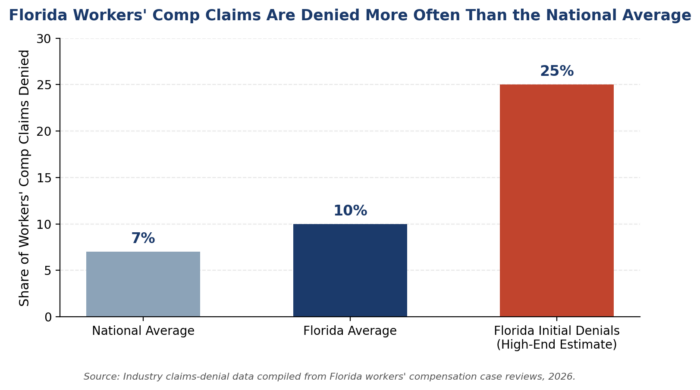
Florida denies a noticeably higher share of workers’ comp claims than the national average, which raises the stakes of a favorable IME outcome.
Why IMEs Carry So Much Weight in Florida
Florida workers already face one of the toughest claims environments in the country. National denial rates average around 7 percent, while Florida runs closer to 10 percent overall, and some case reviews put initial denials as high as 25 percent of claims filed. With premiums dropping for a ninth consecutive year in 2026, carriers are under increasing pressure to control claim costs, and that often translates into more aggressive use of tools like IMEs to question ongoing treatment, dispute impairment ratings, or challenge whether a condition is even work related. If your case involves a reduced work schedule under FMLA or an ongoing dispute over your weekly compensation rate, the outcome of an IME can shape both.
What Happens During the Exam
- The physician reviews your medical records and asks about your injury, symptoms, and how they affect daily activities.
- A physical evaluation follows, which may include range-of-motion testing, strength testing, or reflex checks depending on the injury.
- The exam is typically brief, often 20 to 45 minutes, and is not intended to provide treatment.
- You have the right to bring your own physician, an observer, or a court reporter to the exam in many circumstances.
- The IME doctor prepares a written report that goes to the insurance carrier and becomes part of the official claim file.
Attorney Insight: How to Prepare
Scott Sternberg and Gregory Forsythe consistently advise clients to treat an IME as an extension of the legal case, not a medical appointment. Answer questions honestly and directly, but avoid volunteering information beyond what is asked, and never minimize or exaggerate your symptoms. Bring a written list of your current limitations, keep a copy of your accident report and medical history handy, and arrive on time to avoid giving the carrier grounds to claim non-compliance. Small inconsistencies between your IME statements and your treating physician’s notes are exactly what carriers look for when building a case to reduce or terminate benefits.
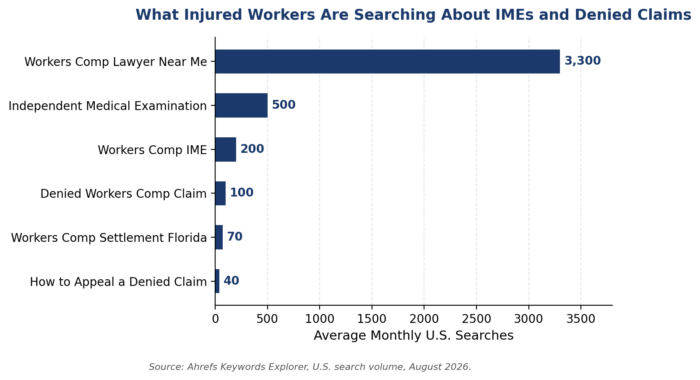
Search interest shows injured workers researching IMEs and denied claims well before they ever call an attorney, which is why understanding the process early matters.
What Happens After the IME
Once the carrier receives the IME report, it may use the findings to approve continued treatment, reduce your benefit rate, place you at maximum medical improvement earlier than expected, or deny further care altogether. If the IME conclusions conflict with your authorized treating physician’s opinion, Florida law allows the dispute to be resolved through a Petition for Benefits before a Judge of Compensation Claims. This is often the point in a case where legal representation matters most, since the burden shifts to proving your treating physician’s opinion should carry more weight than the carrier’s chosen examiner.
What If You Disagree With the IME Report
Disagreeing with an IME finding does not mean the case is over. You can request your treating physician respond directly to the IME report, use your one-time employee IME if you have not already used it, or, in a growing number of 2026 disputes, challenge the report on grounds like the “major contributing cause” standard for pre-existing conditions, which carriers are scrutinizing more closely this year. An attorney can also cross-examine the IME physician’s methodology, prior relationship with the carrier, and history of findings in similar cases, all of which can undercut a report that was never truly independent to begin with.
What Happens When You Call Sternberg | Forsythe
When you call our office about an upcoming or completed IME, we start by reviewing your claim file, your medical records, and the IME notice itself to confirm the carrier followed proper procedure. We then walk you through exactly what to expect, prepare you for the exam, or, if the report has already come back, evaluate whether it supports a Petition for Benefits. We represent injured workers throughout Boca Raton, West Palm Beach, and the surrounding areas, and we do not charge a fee unless we recover benefits on your behalf.
Frequently Asked Questions
Can I refuse to attend an IME in Florida?
Refusing a properly noticed carrier IME can result in suspension of your indemnity benefits, so most injured workers should attend and document any concerns about the exam’s fairness or scheduling.
Who chooses the doctor for a carrier-requested IME?
The insurance carrier selects the physician, and that doctor must be licensed and actively practicing in Florida under Fla. Stat. § 440.13(5).
Do I have to pay for a carrier-requested IME?
No. The carrier pays for its own requested exam. You are typically responsible for the cost only if you request a one-time IME yourself.
Can an IME report end my workers’ comp benefits?
Yes. If the IME physician finds you are at maximum medical improvement or disputes the work-relatedness of your condition, the carrier can use that report to modify or terminate benefits, which can be challenged with legal help.
How soon should I speak with an attorney after being scheduled for an IME?
As soon as you receive the notice. Early preparation gives you and your attorney time to review your file and address any documentation gaps before the exam takes place.
