


Reviewed by Scott J. Sternberg, Florida workers’ compensation attorney, with decades of experience representing injured workers in Florida. Last legally reviewed October 2026.
Repetitive stress injuries are covered by Florida workers’ compensation, but they are harder to prove than a sudden accident. Florida courts require three things: prolonged exposure to a work activity, a causal link between that exposure and the injury, and proof that the job exposed you to a hazard greater than the general public faces. Because there is no single accident date, workers need to report early and build a strong medical record.
A repetitive stress injury, also called a repetitive motion injury, cumulative trauma injury, or overuse injury, develops from the same movement or strain repeated over weeks, months, or years. No fall or crash points to it. Instead, pain and weakness build slowly until a worker can no longer do the job the same way. These injuries are common across the types of workplace injuries we see, and they are among the most frequently disputed.
Common Repetitive Stress Injuries in Florida Workplaces
Florida’s economy runs on jobs that involve the same motion thousands of times a week. Warehouse pickers, nurses and aides, hotel housekeepers, construction trades, assembly workers, cashiers, and office staff all face repetitive strain. The injuries that come up most often include:
- Carpal tunnel syndrome: compression of the median nerve in the wrist, often tied to gripping, typing, or tool use. Our guide to carpal tunnel syndrome and Florida workers’ comp covers these claims in detail.
- Tendinitis and tenosynovitis: inflammation of tendons in the shoulder, elbow, wrist, or hand from repeated motion or force.
- Cubital tunnel syndrome and epicondylitis: elbow nerve and tendon conditions linked to repeated bending, gripping, or twisting.
- Rotator cuff injuries: shoulder damage from overhead work, reaching, and lifting.
- Back and neck strain: injuries from repeated bending, lifting, or awkward posture, which overlap with overexertion injuries.
- Knee damage: wear from kneeling, squatting, and climbing, common in flooring, plumbing, and construction work.
The Legal Test for Repetitive Trauma in Florida
Florida’s standard for repetitive injuries comes from Festa v. Teleflex, Inc., a 1980 decision from the First District Court of Appeal that courts still apply today. To prove a repetitive trauma claim, a worker must show:
- Prolonged exposure: the work activity was repeated over a meaningful period, not a single day or a brief stretch.
- A causal relationship: the exposure caused the injury, or it aggravated a pre-existing condition.
- A greater hazard than the general public faces: the job exposed you to that activity materially more than people experience in everyday life.
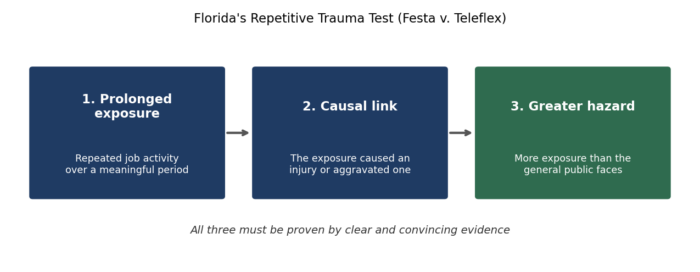
The third element causes the most confusion. The hazard does not have to be unique to your job. Florida courts have held that the question is whether your workplace exposure is materially greater than what the general public experiences. Everyone reaches overhead now and then, but a worker who spends shifts with arms raised above shoulder level is exposed far more than the average person. The test does not require proof that your employer broke a safety rule or exceeded an OSHA standard.
Florida also holds repetitive exposure claims to a higher burden of proof. Instead of the usual preponderance of the evidence, the worker must prove the claim by clear and convincing evidence. That is why documentation matters so much more in these cases than in a typical slip or fall.
Repetitive Injuries vs. Sudden Accidents
| Issue | Sudden Accident | Repetitive Stress Injury |
| Date of injury | A specific day and time | Usually the initial manifestation or diagnosis |
| Witnesses | Often someone saw it happen | Rarely, since the injury builds over time |
| Burden of proof | Preponderance of the evidence | Clear and convincing evidence |
| Key evidence | Incident report, witness statements | Job duty records, medical causation opinion |
| Common carrier defense | The accident did not happen at work | Hobbies, aging, or a prior condition caused it |
Deadlines for Gradual Injuries
The lack of a clear accident date creates real timing risk. Florida generally requires a worker to notify the employer within 30 days of the injury or its initial manifestation. For a repetitive injury, the clock often starts when symptoms are diagnosed or reasonably connected to work, not when you first felt some soreness. Waiting to see if it gets better is one of the most common ways these claims are lost.
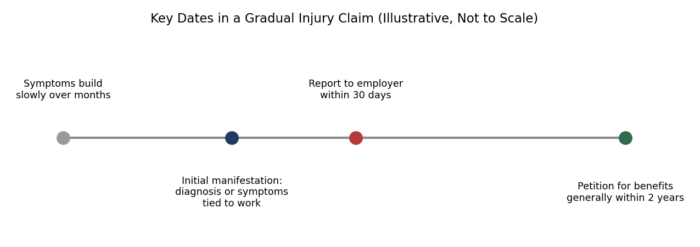
A petition for benefits generally must be filed within two years of the date of injury, or within one year of the last benefit payment if that is later. Our overview of time limits in Florida workers’ comp cases explains how these deadlines work and where the exceptions are.
How Carriers Fight Repetitive Stress Claims
Because there is no single incident, insurance carriers have more room to argue that something other than work caused the problem. Expect some combination of these defenses:
- Your hobbies or home activities, such as gardening, gaming, or sports, caused the condition
- The condition is age-related or degenerative rather than work-related
- You had symptoms or treatment before this job
- Your job duties were not repetitive enough to create a greater hazard than everyday life
- You reported too late
When a pre-existing condition is involved, the work exposure must also be the major contributing cause of the need for treatment under section 440.09, Florida Statutes, which requires medical evidence. Workers in high-repetition settings, such as warehouse workers and office employees, regularly see these defenses.
Evidence That Builds a Strong Repetitive Injury Claim
- A written job description, along with your own detailed account of daily tasks, repetitions, weights, and hours
- Production records, quotas, or scan rates that show volume over time
- Coworker statements describing the same duties
- Medical records that track when symptoms began and how they progressed
- Diagnostic testing, such as nerve conduction studies or imaging
- A physician’s written opinion connecting your job duties to the diagnosis
Scott J. Sternberg on Proving Repetitive Injuries
“With a repetitive injury, the case is really about the job itself. We want to know exactly what our client did all day, how many times, for how long, and with how much force. When a doctor can see a detailed picture of those duties, the connection between the work and the injury becomes much harder for an insurance company to dismiss.” Scott J. Sternberg, Sternberg | Forsythe, P.A.
Was your repetitive injury claim denied or delayed? Gradual injuries take careful proof, and the right evidence can change the outcome. “Scott Sternberg got me all of my workers’ compensation benefits quickly. He negotiated a fair lump sum settlement for me.” John D. Call (561) 687-5660 or contact us online for a free consultation.
Benefits Available for Repetitive Stress Injuries
An accepted repetitive stress claim carries the same benefits as any other compensable injury: authorized medical care, wage replacement while you cannot work or are on restrictions, and impairment benefits once you reach maximum medical improvement. Many repetitive injury cases involve work restrictions, which raises questions about whether you must accept light-duty work. If the authorized doctor dismisses the work connection, a second opinion can be critical.
Frequently Asked Questions
Are repetitive stress injuries covered by workers’ comp in Florida?
Yes. Florida workers’ compensation can cover repetitive stress injuries when the worker proves prolonged exposure, a causal link between that exposure and the injury or aggravation, and a workplace hazard greater than what the general public faces, all by clear and convincing evidence.
What is the Festa test in Florida workers’ comp?
The Festa test comes from Festa v. Teleflex, Inc., a 1980 Florida First District Court of Appeal decision. It requires prolonged exposure, a causal relationship between the exposure and the injury or aggravation, and exposure to a hazard greater than the general public faces.
How long do I have to report a repetitive stress injury in Florida?
Florida generally requires notice to the employer within 30 days of the injury or its initial manifestation. Because repetitive injuries develop gradually, report as soon as you or a doctor connects your symptoms to your job.
Do I need a specific accident date for a repetitive injury claim?
No. Repetitive trauma claims do not require a single incident. The claim is built on the pattern of exposure over time, supported by job duty evidence and medical opinion.
Is carpal tunnel syndrome a repetitive stress injury under Florida workers’ comp?
Carpal tunnel syndrome is one of the most common repetitive stress injuries, and it can be compensable when the repetitive trauma test is met. Carriers often dispute these claims by pointing to non-work activities or prior symptoms.
Can a repetitive job make a pre-existing condition compensable?
It can. Florida law recognizes repetitive exposure that aggravates a pre-existing condition, but the work exposure must be the major contributing cause of the need for treatment, which must be shown by medical evidence.
Common Concerns About Repetitive Injury Claims
“I cannot point to one day I got hurt, so I do not have a claim.” Florida law does not require a single accident for a repetitive trauma claim. The pattern of exposure is the claim.
“Everyone types or lifts, so my job is not different.” The question is how much more you do it than the general public. Hours of daily repetition at work is very different from occasional use at home.
“I will get in trouble if I report this.” Florida law prohibits retaliation for filing a valid workers’ compensation claim. Our article on warning signs of employer retaliation explains what to watch for.
What Happens When You Call
When you call Sternberg | Forsythe, P.A., a member of our team will ask about your job duties, when your symptoms started, what treatment you have received, and whether you have reported the injury. We will ask for any denial letters or medical records you have. The consultation is free, and you will leave knowing whether your situation fits Florida’s repetitive trauma test and what steps protect your deadlines. Learn more about working with a Florida workers’ compensation lawyer and the Florida workers’ compensation claims process.
Talk to a Florida Workers’ Compensation Attorney
A repetitive stress injury can end a career slowly, and the insurance company knows these claims are harder to prove. Sternberg | Forsythe, P.A. represents injured workers throughout Florida, with offices in West Palm Beach, Boca Raton, and Orlando. “They listen to your needs and help you through the whole process.” John Catalo. Call (561) 687-5660 or request a free consultation. Hablamos Español.
