


Quick Answer
Maximum medical improvement (MMI) is the point when your authorized doctor decides your work injury is unlikely to improve further with treatment. In Florida, reaching MMI ends temporary disability checks and triggers a permanent impairment rating, which determines any impairment income benefits. Medical care for your injury continues. Talk with a workers’ compensation attorney before accepting an MMI date or rating you disagree with.
Maximum medical improvement is one of the most important turning points in a Florida workers’ compensation claim. Florida Statutes § 440.02 defines it as the date after which further recovery or lasting improvement is no longer reasonably expected based on reasonable medical probability. That does not mean you are fully healed. It means your condition has stabilized, and your claim moves into a new phase with different benefits and decisions.
Who Decides When You Reach MMI
Your authorized treating physician, the doctor approved by the workers’ compensation insurance carrier, determines when you reach MMI. The doctor bases that decision on your response to treatment, test results, and whether additional care is likely to produce meaningful improvement.
Workers are sometimes placed at MMI sooner than they expect. If you still have significant pain, pending surgery recommendations, or treatment that is helping, an early MMI date can cut off benefits you still need. Understanding the full Florida workers’ compensation claims process helps you recognize when a decision deserves a second look.
What Changes When You Reach MMI
MMI changes almost every part of your claim. The table below summarizes the most common shifts under Florida law.
| Benefit | Before MMI | After MMI |
|---|---|---|
| Temporary disability checks | Temporary total or partial disability, generally capped at 104 weeks | End at MMI |
| Impairment income benefits | Not yet payable | Payable if your doctor assigns a permanent impairment rating |
| Medical treatment | Covered with no copay | Still covered when reasonable and necessary, with a $10 copay per office visit |
| Work restrictions | Temporary restrictions | Permanent restrictions, if any, are assigned |
| Settlement | Harder to value | Easier to value because future needs are clearer |
Your lost wage checks up to this point typically come through temporary disability and lost wage benefits. After MMI, the focus shifts to whether you have a permanent impairment and how it affects your ability to earn a living.
Your Impairment Rating and What It Pays
At MMI, your doctor assigns a permanent impairment rating using the Florida Uniform Permanent Impairment Rating Schedule. The rating is a percentage that reflects the permanent loss of function caused by your injury. Under § 440.15(3), that percentage determines how many weeks of impairment income benefits you receive:
- Two weeks of benefits for each percentage point from 1 to 10 percent.
- Three weeks for each point from 11 to 15 percent.
- Four weeks for each point from 16 to 20 percent.
- Six weeks for each point above 20 percent.
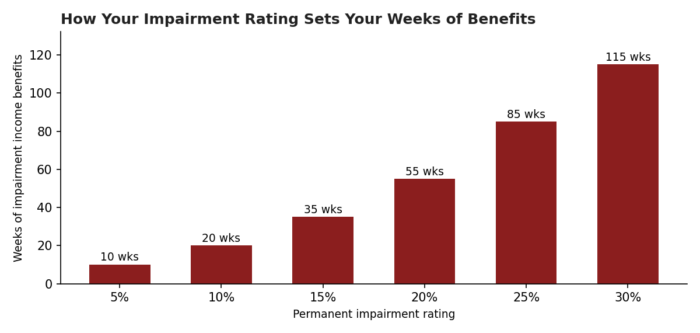
Source: Florida Statutes § 440.15(3). Weeks shown are cumulative totals for each rating.
Impairment benefits are paid at 75 percent of your temporary total disability rate, and they can be reduced by half for any week you earn as much as or more than your pre-injury average weekly wage. Because a few percentage points can add weeks of benefits, your rating’s accuracy matters.
Worried Your MMI Date or Rating Is Wrong?
Sternberg | Forsythe, P.A. has recovered more than $100 million for Florida workers and charges no fee unless you get money. One client, John D., said Scott Sternberg got him all his benefits quickly and negotiated a fair lump-sum settlement. Call (561) 687-5660 or request a free consultation to have your rating reviewed.
How to Challenge an MMI Finding in Florida
An MMI date or rating is a medical opinion, and you can challenge it. Florida law gives injured workers several tools:
- A one-time change of authorized treating physician, which the carrier must respond to within a set period after your written request.
- An independent medical examination, which can provide a competing opinion on MMI, restrictions, and your rating.
- An expert medical advisor appointed by the Judge of Compensation Claims when doctors disagree.
- A petition for benefits asking the judge to order the benefits you believe you are owed.
These steps have deadlines and procedural rules. Our Florida workers’ compensation lawyers handle these disputes routinely and can move quickly when a carrier is using an early MMI date to stop payments.
Permanent Total Disability After MMI
Some workers reach MMI with restrictions so severe that they cannot perform any work within a reasonable distance of home. In those cases, a claim for permanent total disability benefits may be available under § 440.15(1).
Florida courts have also recognized that a worker whose temporary benefits run out before reaching MMI may pursue permanent total disability without first proving MMI, a situation we discuss in our overview of temporary and permanent workers’ compensation benefits.
MMI and Your Settlement
Many Florida workers’ compensation cases settle after MMI because both sides can better estimate the claim’s value. Your impairment rating, future medical needs, and ability to work all shape the value. Before agreeing to any offer, review how workers’ compensation settlements in Florida work and weigh the pros and cons of a lump sum payment, since settling usually closes out future medical benefits as well.
Common Concerns About MMI
My Doctor Says I Am at MMI, but I Still Hurt
MMI does not mean you are pain-free. It means further improvement is not expected. You are still entitled to reasonable and necessary care, and ongoing pain may support a higher rating or permanent restrictions.
Will Hiring a Lawyer Now Upset the Insurance Company?
Carriers work with injured workers’ attorneys every day. Having representation at MMI helps ensure your rating, restrictions, and future care are properly documented before decisions become harder to change.
What Happens When You Call
When you call (561) 687-5660, a member of our team will ask about your injury, your authorized doctor, your current benefits, and whether you have received an MMI date or rating. We will explain what those findings mean for your claim and what options you have. The consultation is free, evening and weekend appointments are available when needed, and you will leave knowing your next steps.
Frequently Asked Questions
Can I still see my workers’ comp doctor after reaching MMI?
Yes. Reaching MMI does not end your medical benefits. The insurance carrier must continue to cover reasonable and medically necessary treatment for your work injury, although you will pay a $10 copay for each office visit after MMI.
What if I disagree with my doctor’s MMI date or impairment rating?
You have options. You may be able to request a one-time change of authorized treating physician or obtain an independent medical examination. If the medical opinions conflict, a Judge of Compensation Claims may appoint an expert medical advisor to resolve the dispute.
Do my weekly checks stop at MMI?
Temporary disability checks stop at MMI. If your doctor assigns a permanent impairment rating, you may begin receiving impairment income benefits instead, and workers who cannot return to any work may qualify for permanent total disability benefits.
Can I return to work after reaching MMI?
Often, yes. Your doctor will assign any permanent restrictions at MMI. If your employer can accommodate those restrictions, you may return to your old job or a modified one. If not, discuss your options with an attorney before accepting a new position.
Is MMI the best time to settle my workers’ comp case?
MMI is often a practical time to evaluate settlement because your future medical needs and permanent restrictions are clearer. Whether settling makes sense depends on your rating, your expected medical costs, and your ability to work.
How long do I have to take action after MMI?
Florida’s statute of limitations generally requires a petition for benefits within two years of the injury or one year from the last payment of benefits or authorized treatment, whichever is later. Missing that window can end your claim.
More Workers’ Compensation Resources
MMI is only one piece of your claim. Our guide to Florida workers’ compensation laws explains the broader rules on medical care and payments, and our workers’ compensation FAQs answer common questions about light duty, depositions, and returning to work. You can also meet attorney Scott J. Sternberg and learn about his background.
Protect Your Benefits After MMI
The decisions made at MMI can affect your income and medical care for years. Sternberg | Forsythe, P.A. focuses exclusively on workers’ compensation and has recovered more than $100 million for Florida workers. One client who handled his own case for almost two years said his only regret was not hiring a workers’ comp lawyer sooner. Call (561) 687-5660 or contact us today. No fee unless you get money.
